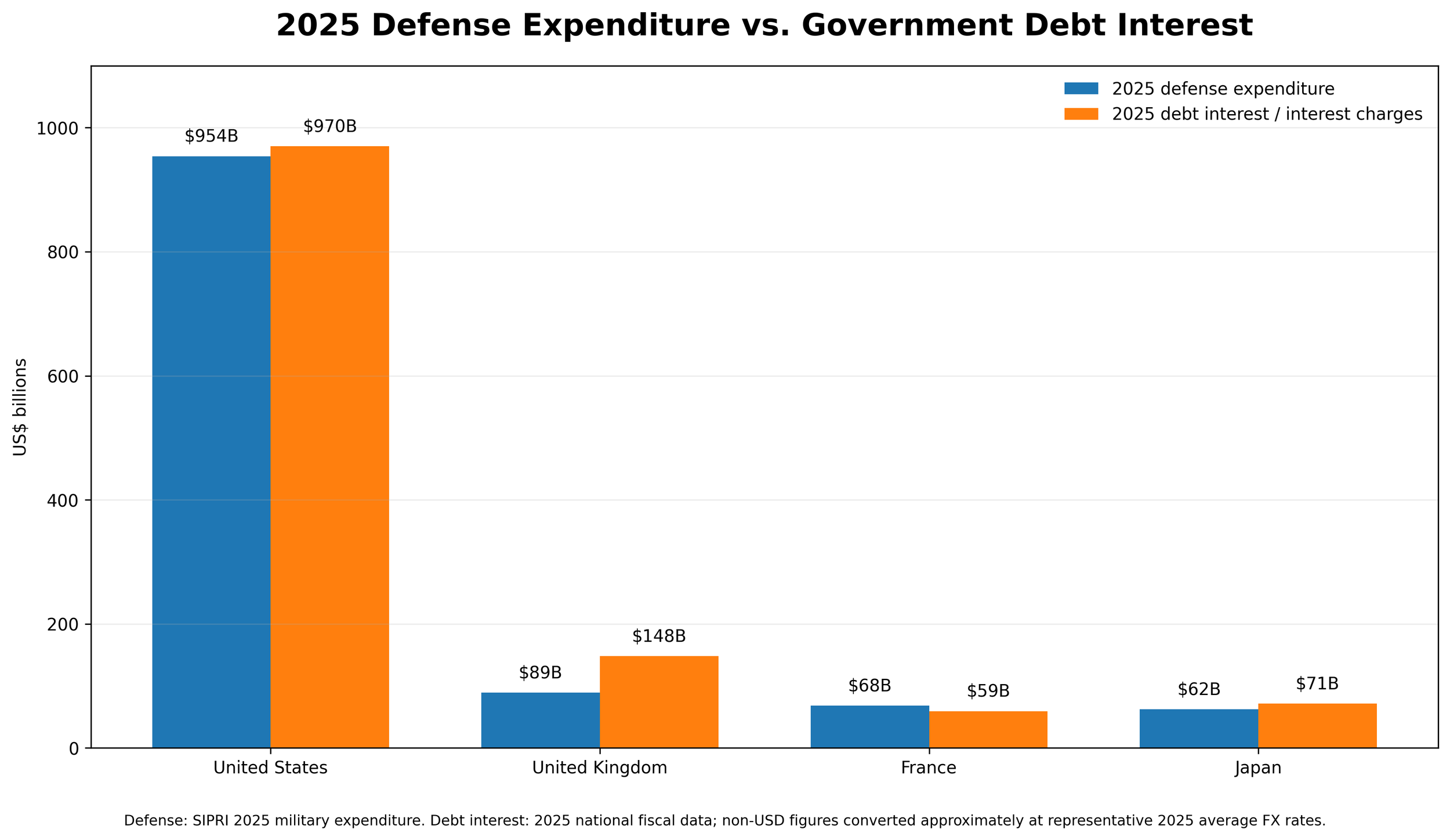
Rearmament Meets the Debt Wall
The era of cheap security has reached an end. Western governments are now finding out the hard way that reversing decades of military downsizing and dismantlement of indigenous defense industries will demand increasingly difficult – and politically unpopular - spending choices.
As central banks end zero-interest rate policies, NATO members and strategic allies face a sharp macro-fiscal crossroad: a structural "guns vs. interest" trade-off.
Soaring borrowing costs are rapidly consuming discretionary revenues. With global defense spending reaching $2.88 trillion in 2025 (with NATO accounting for 55%), expanding military capability now forces hard choices:
🔹Trimming domestic entitlements
🔹Hiking taxes
🔹Accepting structural inflation
Bond markets are taking notice. Yields on U.S. and U.K. 30-year notes recently hit multi-decade highs (5.3% and 5.8%), and Washington’s net interest payments are set to outstrip total defense outlays for FY2026.
To hit NATO’s ambitious targets - 3.5% of GDP for core defense plus 1.5% for security infrastructure - multiple European nations are resorting to creative accounting, stretching traditional NATO definitions of defense spending just to meet benchmarks.
Meanwhile, key Pacific Rim allies face an even tighter squeeze. Under pressure to deter China's military expansion, Japan, South Korea, and Taiwan are expanding defense budgets while navigating severe demographic headwinds. Cutting social safety nets for an aging workforce is politically untenable.
Rearmament is a vital deterrent against great power conflict. But financing it through deficit spending in a high-rate environment leaves governments vulnerable. Should a peer conflict spill beyond Ukraine, nations may face a liquidity crunch that drives short-term yields higher and restricts their ability to sustain a long-term war effort.
While NATO members and their Indo-Pacific partners look to expand industrial capacity to ensure their military readiness and sustainability is not curbed, the other threat - sovereign debt limitations - presents an equally significant challenge.