Private Capital and the Rebuilding of the U.S. Defense Industrial Base Part 1
The Investors
As the U.S. moves to repair, rebuild, and expand its Defense Industrial Base (DIB), private capital is playing an increasingly prominent role alongside the Department of Defense’s (DoD) efforts to accelerate the development of next-generation technologies. To meet growing defense demands and rebuild national industrial capacity, Washington policymakers and defense companies are looking to private investment and strategic partnerships.
This push is creating two principal investment paths: private equity (PE), often deployed through mergers and acquisitions (M&A) to consolidate and expand the existing supply chain, and venture capital (VC), which predominantly targets emerging technologies and new approaches to defense production.
The macroeconomic environment helps explain the trend. According to PwC's aerospace and defense deals outlook, the combined order backlog for the five largest U.S. defense primes (Lockheed Martin, RTX Corporation, Northrop Grumman, Boeing, and General Dynamics) reached $1.36 trillion at the end of fiscal year 2025. While these backlogs signal sustained demand, they also underscore the challenge of converting orders into deliveries amid production constraints, strained supply chains, and pressure to expand capacity.
Meanwhile, U.S. military operations against Iran under Operation Epic Fury in 2026 have highlighted concerns surrounding munitions inventories, production bottlenecks, and available missile stocks. The use of expensive, technologically advanced systems to counter swarms of low-cost Iranian drones has also underscored the unfavorable cost exchange that can arise when defending against relatively inexpensive threats.
In short, the DIB needs greater production capacity and more cost-effective ways to counter emerging threats.
The rationale for private capital entering the defense market comes down to a basic truth: building and sustaining the complex weapon systems fielded by the U.S. military requires substantial upfront investment. When defense primes face uncertainty about how long elevated demand will persist, they may hesitate to commit capital to new factories and production lines.
Capital markets can help bridge this gap by connecting businesses seeking multi-year growth funding with investors pursuing competitive returns. While public appropriations and government contracts underpin major defense programs, private investment can help finance facility expansion, modernize manufacturing, develop dual-use technologies, and address supply-chain bottlenecks.
Aligning these funding streams is central to reshaping the DIB from a concentrated, slow-to-adapt legacy ecosystem into a more resilient industrial network capable of sustained production at scale. And while private capital does not guarantee additional output, it can help finance industrial expansion, improve operational efficiency, and share the upfront investment burden between private investors and the government.
According to PitchBook, global A&D private-equity deal value reached an estimated $50.3 billion in 2025, with $11.3 billion recorded in the first quarter of 2026.
PE firms are targeting Tier 2 and Tier 3 suppliers, consolidating fragmented segments of the defense supply chain. These businesses include component manufacturers, electronics specialists, precision forging and casting operations, as well as maintenance, repair, and overhaul (MRO) providers. Such investments can support facility modernization, operational improvements, and expanded production capacity among the suppliers on which major defense programs depend.
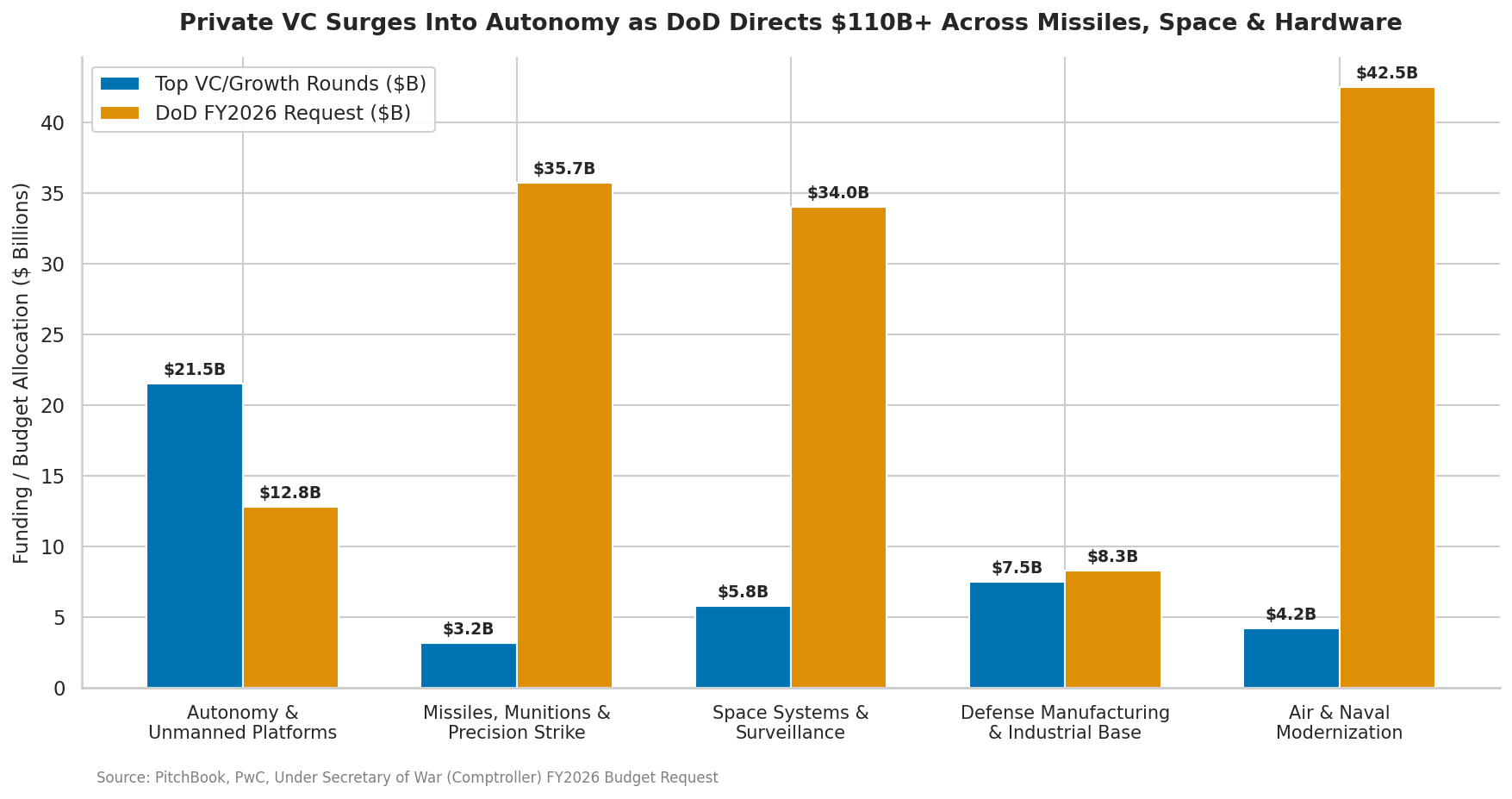
On the VC side, investors are funding emerging defense technologies and, in some cases, the manufacturing infrastructure needed to bring them into production. Examples span advanced manufacturing through Hadrian and Mach Industries, shipbuilding and autonomous naval vessels through Saronic, and missile and weapons development through Castelion and Anduril.
According to S&P Global, defense-focused startups attracted approximately $29 billion in VC funding rounds during 2025.
Separately, PitchBook estimates that defense-tech investment reached $19.8 billion in the first quarter of 2026. (It should be noted that the S&P and PitchBook figures reflect different datasets and methodologies and are not directly comparable.)
VC investment is targeting next-generation capabilities, from autonomous systems to counter-unmanned aerial systems (C-UAS), artificial intelligence (AI), space systems, and software-defined defense.
For years, aerospace and defense M&A was largely about achieving massive scale. Today, the challenge is increasingly about converting investment into production capacity, delivering new capabilities, and meeting demand with greater speed and cost efficiency. The companies best positioned to succeed will be those that translate capital into sustained industrial output and operational advantage.