The Mecca Pact: A New Dimension in Middle East Security
On August 7, 2026, Saudi Arabia, Turkey, and Pakistan signed the Mecca Joint Defense Agreement, introducing a collective security commitment modeled after NATO’s Article 5. This agreement reflects a deliberate push toward regional strategic autonomy as all three nations navigate rising instability across the Middle East, including disruptions in the Strait of Hormuz, growing security concerns involving Iran, and deepening doubts over U.S. deterrence reliability.
The partnership leverages complementary strengths: Saudi capital, Turkey's defense technology, and Pakistan’s military manpower and nuclear capabilities.
For Riyadh, this alignment accelerates Vision 2030 goals to localize over 50 percent of defense spending through technology transfers and joint production. Partnering with Pakistan also offers Saudi Arabia potential access to advanced aerospace engineering and Chinese intellectual property without directly violating U.S. sanctions. This shift represents a practical strategic hedge rather than a total break with Washington.
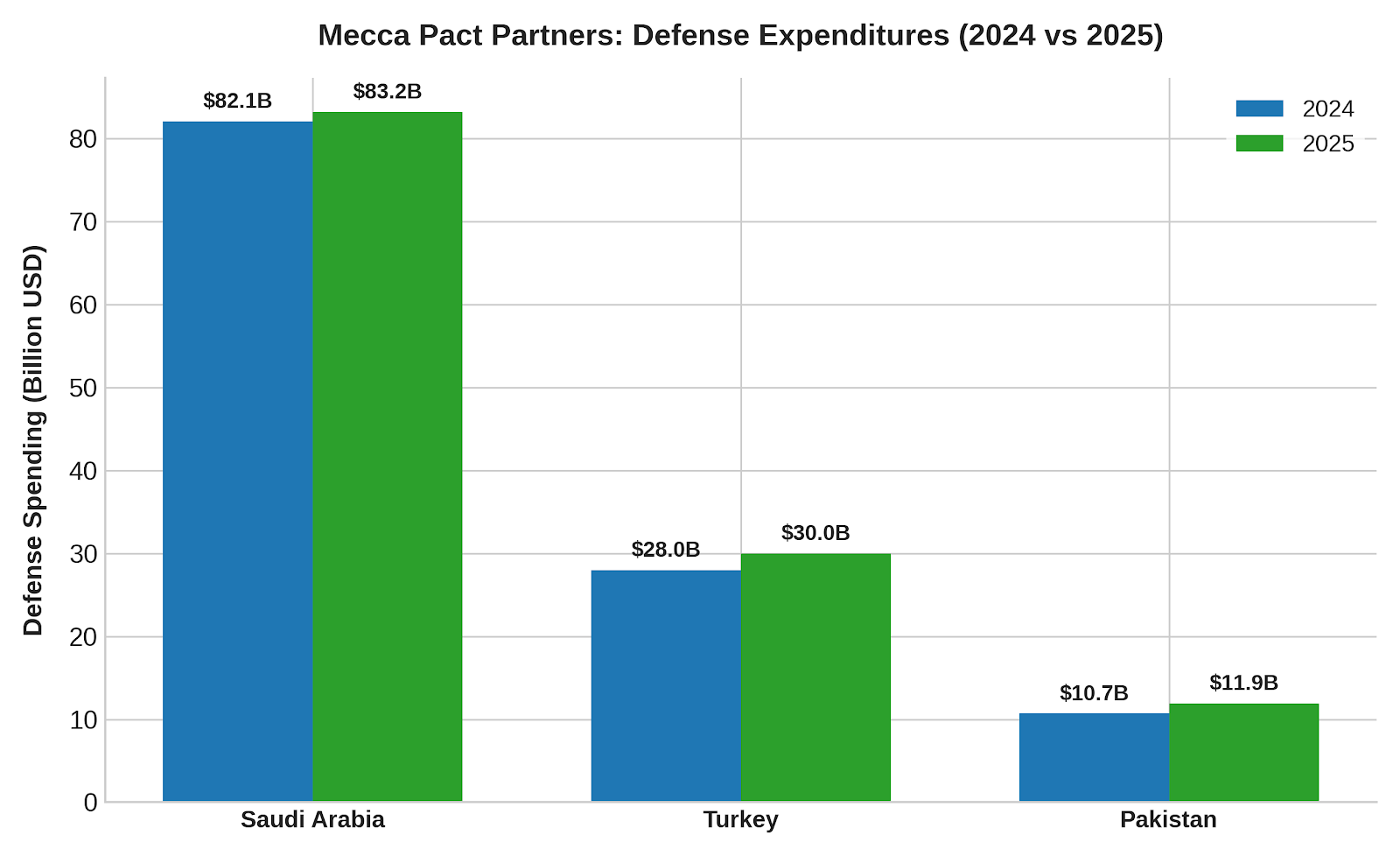
While the alliance represents roughly $125 billion in combined military spending, 1.39 million active personnel, 6,000 main battle tanks, and 800 combat aircraft, its primary value is industrial rather than operational.
Trilateral defense-industrial sharing should unlock joint military tech development, synchronized procurement, and licensed production while bypassing restrictive Western intellectual property controls.
From a geostrategic standpoint, the Mecca Pact introduces a significant security dilemma for Iran, which now faces a coordinated bloc of Sunni powers along its perimeter, including one with a nuclear capability.
Yet despite the NATO-like declaration by the Mecca Pact parties, the reality is there is no integrated central command, no collective force structure or combined rapid response element, and no shared rules of engagement. Instead, each nation confronts their own divergent primary threats.
So, for now, the pact remains a commercial partnership and diplomatic signal. That is its immediate value. Any future movement toward operational integration and allied responses to attacks will be key dynamics to watch.