Industrial-scale War and the U.S. Munitions Crunch
Russia’s invasion of Ukraine in February 2022 provided a reminder to defense planners that peer-on-peer industrial-scale warfare remains a reality. While NATO and NATO-aligned countries rushed to provide material to the Ukrainian military, one immediate observation defense planners could take from operations in the Ukraine theater is that artillery remains a crucial battlefield component.
More importantly, magazine depth and the ability to replenish munitions quickly are critical to ensure sustainable kinetic operations.
Ukrainian forces expend up to 10,000 artillery shells per day. But the U.S. industrial base has struggled to meet Ukrainian demands – or even those of its own Army.
Hence the U.S. military currently faces a critical shortfall in its ability to produce and adapt conventional munitions at the scale required for a major power conflict.
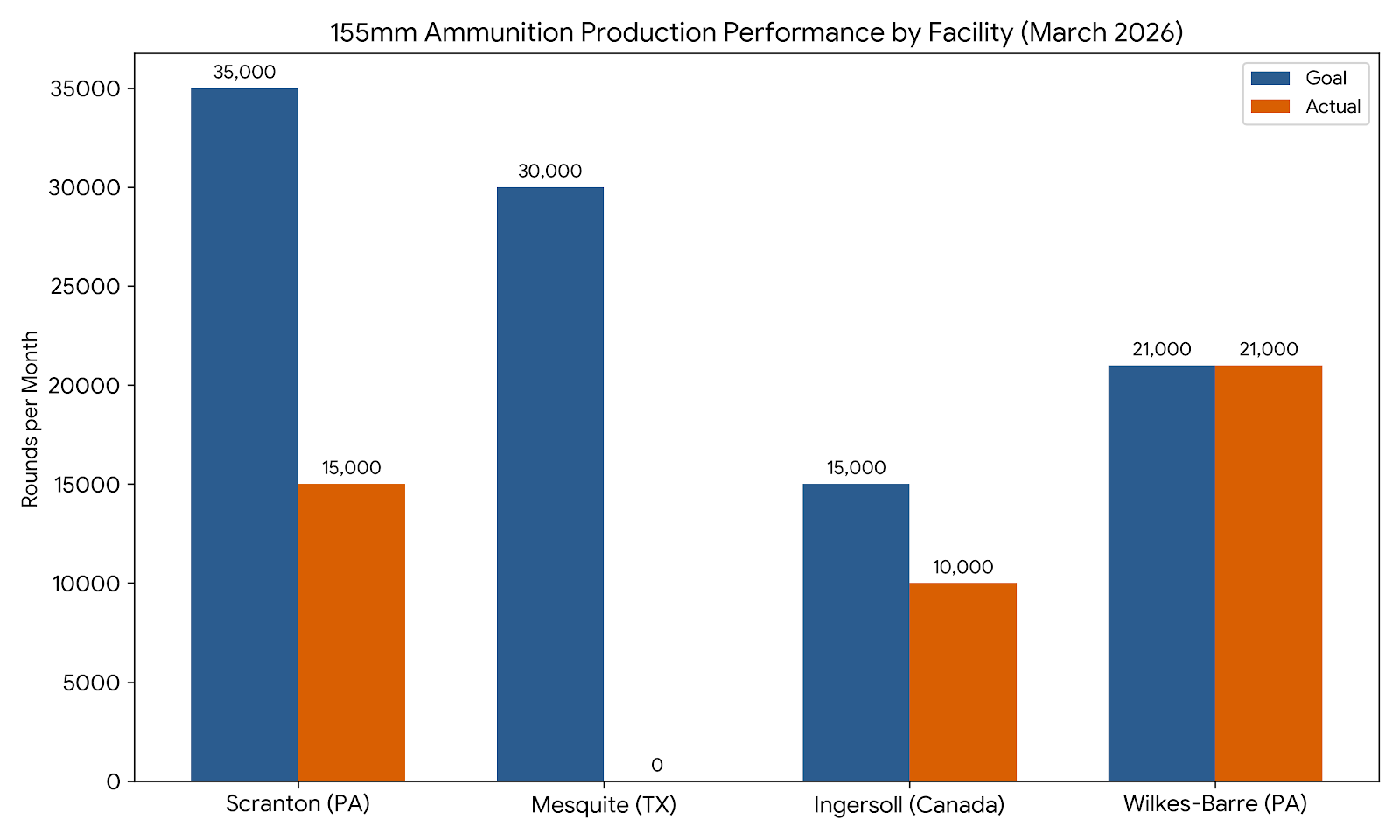
Despite a stated goal to produce 100,000 155mm artillery rounds per month by October 2025, the Army achieved only 36,000 rounds per month as of March 2026.
The reasons for this shortfall are multiple, starting with aging infrastructure at legacy plants like the Scranton Army Ammunition Plant (SCAAP) and the failure of new, "high-risk" facilities such as the contractor-operated plant in Mesquite, Texas.
The latter facility represents one of the biggest failures in the quest to ramp up 155mm munition production.
Following a $469 million invested by the U.S. Army, the General Dynamics Ordnance and Tactical Systems (GD-OTS)-operated Mesquite plant opened in May 2024 to forge steel bodies for M795 155mm high-explosive artillery projectiles. The anticipated delivery rate of contract-compliant shell bodies was targeted at 30,000 shell bodies per month by October 2025. Intended to utilize high-level automation, the facility attempted to adapt equipment meant for the 1958-era M107 shell to produce the newer M795 variant.
The result is that the Mesquite plant has produced zero usable components to date.
Aging infrastructure – particularly within the domestic energetics industrial base, which provides explosives and propellants – remains an issue. Perpetual underfunding and outdated machinery operated long past service-life dates has hampered production.
Vulnerable, foreign-sourced supply chains represent another hurdle, as does decades-long dependence upon lean-scale production, just-in-time delivery models resulting from the lack of supply demand signal and stable budgets from Washington. Adding to U.S. industrial constraints is an aging workforce, shrinking labor pool, and, in some instances, highly specialized assembly processes requiring expert skills.
Finally, there is the inherent “straitjacket” element derived from the U.S. military’s preference for the boutique over the “good enough”, with highly integrated exquisite munitions the standard demand. Under this approach, performance outweighs concern over production time and scalability.
But in an industrial scale war with a peer foe, the more-capable munition is of little use if it arrives late and requires lengthy production timelines for replacement. To prepare for such a potential conflict a new approach – one focused on mass and adaptability, not simply exquisite capability predicated on artisan, bespoke engineering – will be required.
Until then, the long job of rebuilding scalable defense production will remain an uphill process.